
Pakistan's New Government Will Struggle Amid Economic and Political Challenges
Pakistan's New Government Will Struggle Amid Economic and Political Challenges
4 MIN READApr 13, 2022 | 21:30 GMT
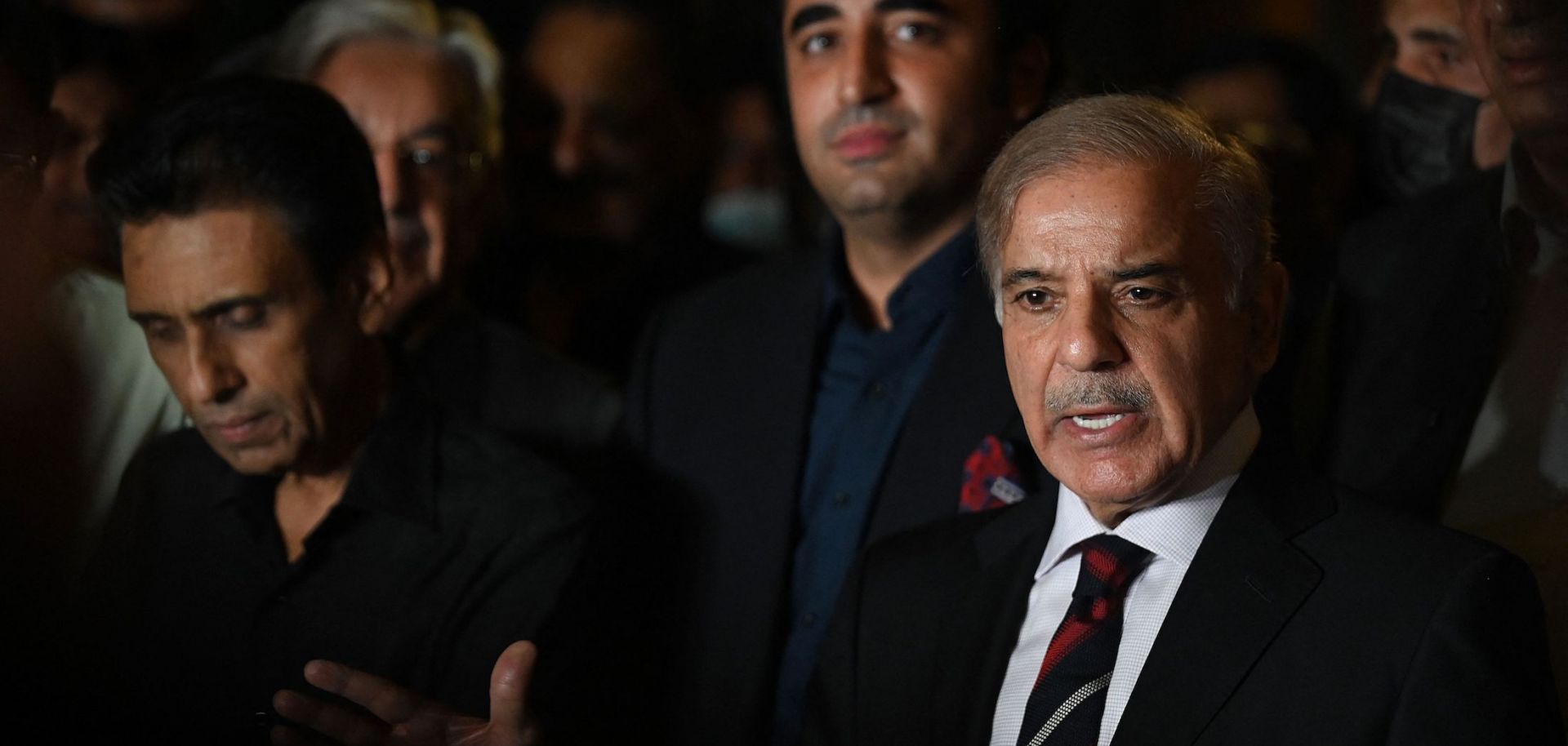 |
Pakistani Prime Minister Shahbaz Sharif (R) in Islamabad on April 7, 2022. (AAMIR QURESHI/AFP via Getty Image |
Pakistan's new government will face mounting economic challenges and political instability as it tries to hold itself together and improve ties with the United States and traditional allies. Pakistan's National Assembly on April 11 appointed Shehbaz Sharif as the country's new prime minister after former Prime Minister Imran Khan lost an April 10 vote of no confidence. This happened after the Pakistani Supreme Court on April 7 overruled a decision by the speaker of the National Assembly to cancel the vote against Khan and dissolve Parliament.
- Shehbaz Sharif, the brother of former prime minister Nawaz Sharif, has been the chief minister of Punjab province three times. In 2018, he was elected to the National Assembly, where he was the leader of the opposition.
The new administration will face significant economic and political challenges in the short to medium term that will threaten the government's stability. The new government has inherited a fragile economy and an unstable social and political environment. The Pakistani economy is facing high fiscal and current account deficits and high inflation rates, in part due to the country's dependence on foreign oil, natural gas and other essential imports. The new government is expected to negotiate with the International Monetary Fund for the disbursement of the next tranche of a $6 billion bailout package. The IMF will likely require strict and unpopular economic reforms that will be difficult for the government to implement without generating social unrest. Additionally, Khan will continue to mobilize support for his party ahead of the mid-2023 general elections and will likely double down on his allegations that a foreign conspiracy caused his fall. Unpopular economic reforms could give Khan's party a window of opportunity for mobilizing supporters and bringing them to the streets. It will be difficult for Sharif to gain public support for his administration, because he was accused (though later acquitted) of corruption and belongs to a family that has faced similar accusations. Keeping his supporters together and finishing his term in office could also prove an uphill task, as his government will include different parties like the Pakistan Muslim League-Nawaz (PML-N), Pakistan People's Party (PPP) and others that have competed before, and whose policy preferences and ideologies could still collide. Early elections could also be called if the different parties that form the government cannot work together, enhancing the country's political instability.
- Pakistan's foreign reserves had dropped to $11.3 billion by April 1 from $16.2 billion in the previous month. Pakistan's projected current account deficit is 4% of gross domestic product.
The government is likely to work with the military on national security and foreign policy issues, and to strengthen relationships with traditional allies — including seeking to improve ties with the United States, albeit modestly so. Unlike his predecessor, Sharif is expected to work with the military establishment, which largely directs the country's defense and foreign policy and remains influential in domestic politics, to remain in power. Pakistan's relationship with China could strengthen because Shehbaz Sharif's regional government and Nawaz Sharif's former national government have been instrumental in China's Belt and Road Initiative projects in the country. China will likely be interested in preserving the strategic relationship with Pakistan, though security issues (including the regional militant threat to Chinese projects and workers) could affect the economic aspects of the partnership. Pakistan's relationship with Saudi Arabia is also likely to remain strong, as the Sharif family has a close relationship with the Gulf state, a strategic ally that remains an important development and military partner for Pakistan. Finally, the Sharif government will very likely seek to improve Pakistan-U.S. relations, which deteriorated recently due to Khan's allegations that the United States wanted to remove him from office. Since Pakistan's next general elections are in August 2023, the new government probably will not have enough time to deal with both domestic economic and political priorities, which could limit its reorientation toward the United States. Some form of rapprochement with India is possible under Sharif, as evidenced by recent talk from the Pakistani military about dialogue with India to resolve the Kashmir issue. The dispute over Kashmir will, however, continue to generate bilateral tensions, as could growing discrimination and violence against Muslims in India.
- Shehbaz Sharif's provincial government signed many Belt and Road Initiative developmental projects when he was a regional leader, and Pakistan entered the strategic China-Pakistan Economic Corridor deal during the Nawaz Sharif government.
- The Sharif brothers enjoyed protection in Saudi Arabia, where they were exiled after a 1999 military coup in Pakistan, and still enjoy a close relationship with the Saudi royal family.
- Turkey, China and India were among the first countries to congratulate the new prime minister of Pakistan.
- On April 2, Pakistan's chief of army staff stated that all disputes with India should be settled through diplomacy.
- Get link
- X
- Other Apps


Comments
Post a Comment